Enterprise
Document infrastructure for the global enterprise
Translate contracts, filings, reports and decks across 120+ languages — formatting intact, approved terminology applied and enterprise controls built in. Run it in Bluente’s cloud or inside your own network.
No credit card required · Your first translation in minutes.





Secure from the first upload
Confidential documents should not require a leap of faith. Bluente protects every file, gives administrators control over every user and provides the evidence your security team needs.
Protect every document
Encrypted in transit and at rest, automatically deleted within 24 hours and never used to train shared models. Pin the processing region or keep documents inside your own environment.
Control every user
SAML and OIDC single sign-on, multifactor authentication, role-based permissions, separate workspaces and audit logs — on the identity system your team already runs.
Give reviewers the evidence
SOC 2, ISO/IEC 27001, GDPR, DPA, SCCs and a documented subprocessor chain. Visit the Trust Center →
Built for the documents global enterprises actually move
One platform, one glossary and one security posture across the document workflows your teams already manage.
Credit, lending and counterparty files
Credit proposals, facility agreements and counterparty financials out of Mandarin, Japanese and Korean — tables, footnotes and number formats intact for the analyst who has to spread them.
Legal & legal operations
Cross-border contracts and redlines with tracked changes intact. Closing binders. Powers of attorney. The mixed-language email thread nobody can read past the third reply.
Fund, investor and corporate-action documents
Prospectuses, KIIDs, subscription documents, IMs and board packs, plus corporate action notices and trust deeds — often scanned, often decades old, always time-bound.
Compliance & regulatory affairs
Submissions, KYC and onboarding packs, and policy that reaches every regional entity in the wording the regulator already approved — including material that only ever arrives as a scan.
Learning & development
Mandated training and certification workbooks localised for every region at once. Nobody rebuilds a 200-slide deck because German ran a third longer than English.
Engineering & product
A translation API and an MCP server. Same engine, same glossary, same security posture behind whatever you build. See integrations →
Translate at scale without losing control
From terminology to final review, every enterprise rule stays attached to the document.
Terminology, locked across every document
At scale the failure is never one bad word. It is the same word rendered two ways across a document set assembled over three weeks by four people. Your glossary applies as a constraint on the engine, not a suggestion to it — so page 1 and page 400 agree, and so do twelve documents from the same matter.
- Entity names, defined terms and units identical throughout
- Do-not-translate list for names, tickers, citations and trademarks
- Scoped per workspace, so teams keep separate lists
- No cap on entries, and we will build the first list with you
A model trained on your own approved work
A glossary fixes words. Tuning fixes voice — the register a regulator expects, the sentence shape your firm actually writes in. Two to five languages, four to six weeks, trained on bilingual documents your team has already signed off. Anonymised, exclusive to you, deleted when the work is done.
- Trained on your material, for your workspace only
- Never merged into a shared model other customers touch
- A structured feedback loop, not a one-off upload
- Most teams never need it — the glossary comes first
Payment must be made before the stated date.
Payment shall be made on or before the due date.
Only the redlines, when only the redlines changed
Version 8 of an agreement is not a new document. Delta translation handles what changed, with tracked changes, insertions, deletions and comments preserved along with their authorship. The difference between reviewing a page and reviewing a binder — and review, not translation, is where the cost sits.
- Tracked changes and comment anchors preserved
- Translate an updated version without re-reviewing the whole file
- Bilingual side-by-side output for verification in one document
- Built for the deal where you need to see what the counterparty moved
Quality you can put a number on
Translation Checker scores any original and translation from 0 to 100, with deterministic checks on numbers, dates, currency and glossary compliance. It runs on work somebody else produced — which is how most enterprise teams first use it, to grade the agency output they already pay for.
- Numbers, dates and currency checked, not just wording
- Terminology graded against your own glossary
- Works on third-party and agency translations too
- Gives review a place to start rather than a full re-read
Built for complete documents, not extracted text
Upload the files your teams already use. Bluente preserves the structure that makes them usable and returns the output in the format the next reviewer needs.
Files in
Word, Excel and PowerPoint; native and scanned PDFs; photographed exhibits; and image files including PNG, JPG and TIFF.
Structure preserved
Tables, financial statements, tracked changes, comments, clause numbering, cross-references, layouts and brand fonts remain part of the document.
Review-ready output
Translate into 120+ languages, produce several languages from one upload, or return a bilingual side-by-side file for verification.
Runs where your enterprise needs it to run
Your infrastructure, and your own models
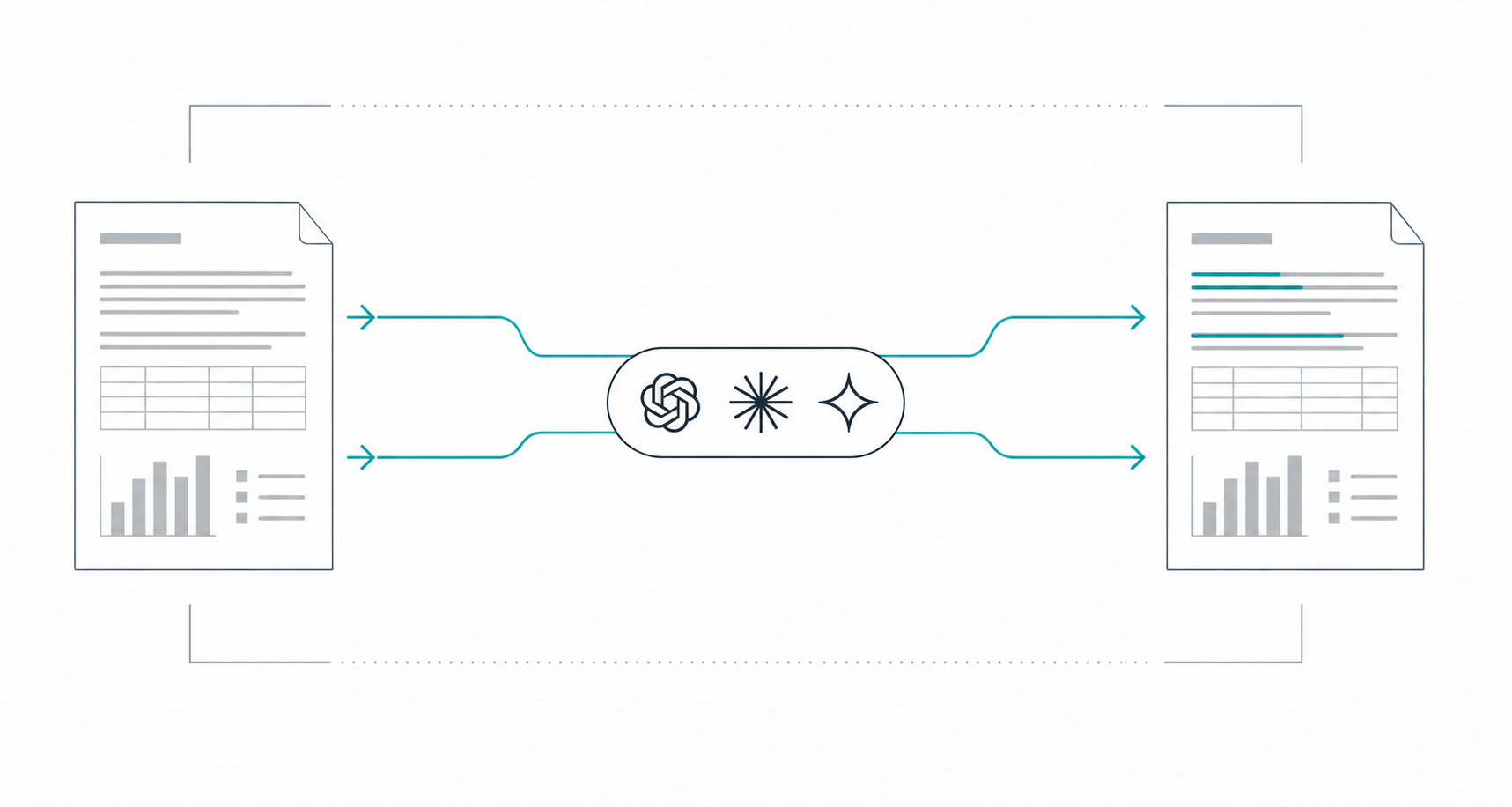
The most demanding deployments come from institutions that already run their own models centrally and will not send documents outside their perimeter. The answer is not to move their data. It is to run Bluente as the document layer on top of the models they have already approved. Parsing, terminology, reassembly and quality are ours. The model and the data stay yours.
- Multi-tenant, single-tenant, your own cloud tenancy, or on-premise
- Runs against your own approved models where you already host them
- Container images built to pass your scanning and hardening requirements
- Architecture, infrastructure and deployment documentation provided
Four places it can run
Every step away from multi-tenant buys control and costs something real. Usually update cadence, sometimes capability.
| Deployment | Where documents sit | Who runs it | The trade-off |
|---|---|---|---|
| Multi-tenant default | Our infrastructure, region-pinned, auto-deleted within 24 hours | Bluente | None in capability. Newest models and the full language set, day one. Right for most enterprises, including most regulated ones. |
| Single-tenant | A dedicated instance, isolated from other customers | Bluente | Higher cost. Updates arrive on a schedule rather than continuously. |
| Your own cloud | Your AWS or Azure tenancy. Documents never leave your account. | Shared | You carry infrastructure cost and an upgrade window. Feature coverage can lag the hosted product. |
| On-premise | Inside your network, no outbound connection required. Can run against your own hosted models. | You | The largest capability gap and the slowest to update. Right when a client mandate or a regulator forbids everything above. |
Adoption without enterprise lock-in
Pay for the documents you translate, let every authorised colleague use the platform and start before a group-wide rollout is negotiated.
Per page, predictable
Under $0.60 per page, against $0.10 to $0.20 per word at an agency. A quote does not move because a language is verbose.
Unlimited users
No per-seat licensing on any tier. Seat counts decide who is allowed to work, and the answer is always fewer people than need to.
Blocks, not lock-in
Buy a block of pages, top up mid-year if usage spikes. No minimum annual pre-buy. One department can start before anyone negotiates a group agreement.
Frequently asked questions
How is it priced at enterprise scale?
What does it replace?
Can it run inside our own network, on our own models?
Are our documents used to train models?
Where is data processed, and what can we audit?
How accurate is it on our material?
Do you handle scanned documents and redlines?
Can we start with one team?
See your hardest document come back intact
A real file, a real language pair and your terminology applied. That settles more than another feature comparison.